Tel: +86-134-31394972
E-mail: sales@pre-webguidesystem.com
Tel: +86-134-31394972
E-mail: sales@pre-webguidesystem.com
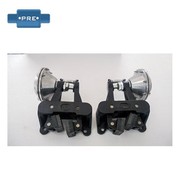
Brake staff can be divided into two categories, industrial brakes and vehicle brakes. Automotive brakes are divided into service brakes (foot brakes) and parking brakes (hand brakes). In the driving process, the service brake (foot brake) is generally used to facilitate deceleration and stop during the forward movement, not only to keep the car stationary. The parking brake is used if the service brake fails. When the car is stopped, use the parking brake (handbrake) to prevent the vehicle from moving forward and backward. After parking, generally, in addition to the parking brake, the upslope parking should be carried in the first gear (to prevent the rear), and the downhill parking should be in the reverse gear (to prevent the forward).
The resistance torque that must be applied to stop or decelerate the mechanical running component is called the braking torque. The braking torque is the basis for the design and selection of the brake. The size is determined by the type of the machine and the working requirements. The performance of the friction material (brake) used on the brake directly affects the braking process, and the main factors affecting its performance are the operating temperature and the temperature rise rate. The friction material should have a high and stable coefficient of friction and good wear resistance. Friction materials are classified into metal and non-metal. The former is commonly used in cast iron, steel, bronze and powder metallurgy friction materials, the latter including leather, rubber, wood and asbestos.
The brake for cranes in industrial brakes is both a working device and a safety device for the crane. In the hoisting mechanism, the lifting or lowering of the cargo can be smoothly stopped at the required height or the speed of lifting or lowering is controlled. In mechanisms such as running or luffing, the brakes allow the mechanism to stop smoothly at the desired position.
Previous: Brake development prospects

 русский
  Deutsch
 Latviešu
 اردو
اردو slovenščina
 Polski
 বাংলা
বাংলা bosanski
 magyar
 Srbija jezik (latinica)
 România limbi