Tel: +86-134-31394972
E-mail: sales@pre-webguidesystem.com
Tel: +86-134-31394972
E-mail: sales@pre-webguidesystem.com

Teflon spray coatings often precipitate during transportation and storage, such as pigments and fillers sinking, which are not effective after shaking. The reason for this is that the pigment or the body pigment particles are not finely ground, the dispersion is poor, the filler is more, the pigment reacts with the paint base or adsorbs correspondingly, or the storage phase is long, resulting in precipitation. The prevention method is:
The paint is often moved during storage, and the method of placing the barrel is reversed, such as horizontally and vertically. Do not store for too long, repeatedly flow, shake before use, or pour out all the paint, stir well. Some anti-precipitation agents such as aluminum stearate, hydrogenated castor oil, modified bentonite, and the like may also be added.
Teflon paint or varnish loses its consistency, thickens, thickens, or even cannot be used during storage. This is the thickening of the paint. The thickening of the paint is mainly because the pigment reacts with the paint base, and the base pigment such as zinc white, aluminum white and the like reacts with the organic acid in the paint to form a metal soap. Pay attention to the use of Teflon paint to prevent cracking of the paint.
This is a very fine crack that constantly penetrates the paint until it "breaks through" the entire paint layer. The initial cracks are hard to find. It is already more serious when the naked eye can detect it. When waxing and polishing, you will find that the body has streaks, which is due to the presence of car wax in the cracks. Due to the quality problems of the paint, the resin in the paint will also be cracked due to "atrophy". This "skin disease" can only be cured by repainting.
Teflon additive has been added to the production of Teflon spray
Release time:2016-12-16 Share to:
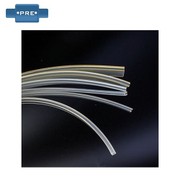
When a small amount of conductive additive is added during the manufacture of Teflon spray, when it is used as a hose for the aerospace industrial hydraulic system, there is a danger of static electricity due to accumulation of static charge due to friction during the high-speed flow of the hydraulic oil. A small amount of conductive additive must be added during the manufacture of the FE inner tube, typically carbon black or graphite. Eliminate static electricity and increase safety performance, that is, the inner layer of the pipe is a certain proportion of uniform mixture of conductive graphite and PTFE, and the outer layer of the pipe is pure PTFE. This form of inner tube layer has electrical conductivity.
The main use of the dispersed Teflon spray hose is to transport hydraulic fluids in the aerospace industry, such as pressure vessels used for high-speed fuel delivery in spacecraft such as jets and rockets. High-pressure air in the automotive industry, transportation of highly corrosive media in the chemical industry, and passage of high-purity fluids in the pharmaceutical industry. In the civil industry, it is suitable for rubber, plastic, pharmaceutical, clothing, shipbuilding, automotive, machine tools, electric welding machines, diesel engines, papermaking and other industries for hydraulic, steam pressure, steam delivery and other soft connectors.
The process is as follows:
Inner layer resin (including conductive material) → outer layer resin → mixed compact → extrusion molding → high temperature sintering → cooling → setting → inspection → weaving → fitting → inspection
PTFE steel wire composite hoses are mainly used in hydraulic systems, air-conditioning systems, fuel systems and Teflon spray oil systems on aircraft.