Tel: +86-134-31394972
E-mail: sales@pre-webguidesystem.com
Tel: +86-134-31394972
E-mail: sales@pre-webguidesystem.com
Abstract: This paper mainly introduces the characteristics of magnetic powder clutch and magnetic powder brake and their application in the tension control system of sheet metal strip mill. It also provides the basis for selecting the brake and clutch in the design of rolling mill.
Keywords: magnetic powder clutch, magnetic powder brake, strip and strip, rolling mill, web tension control.
In most of the strip and strip mills currently used in the domestic metallurgical industry, the DC speed-regulating motor is used to drive the winding roller to obtain the take-up tension. The tension before rolling is generally achieved by adding a damping mechanism such as a brake to the unwinding roller. In this way, during the rolling process, the tension of the material is difficult to grasp and control, which seriously affects the stability of the product quality. Moreover, the actual operation of the workers is difficult, which affects the process of automating the entire production process.
From the internationally advanced sheet and strip production line introduced by the metallurgical industry in recent years, it can be seen that the tension control of unwinding and winding of materials has generally been achieved by using magnetic powder brakes and magnetic powder clutches.
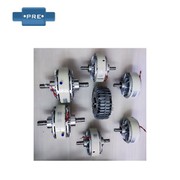
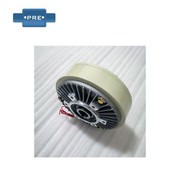
Magnetic powder clutches (including brakes) are a new type of automatic control actuator. It uses magnetic powder to transmit torque according to electromagnetic principles. The transmitted torque can be arbitrarily adjusted within its rated torque. The magnetic powder clutch structure is shown in Figure 1. It consists mainly of a stator and inner and outer rotors. A coil is arranged in the stator to generate a magnetic field by direct current. The inner and outer rotors are filled with magnetic powder, and a magnetic powder chain is formed in the magnetic field to connect the inner and outer rotors. The utility model has the advantages that the excitation current and the transmission torque are linear in a certain range, and the constant torque output can be independent of the slip size and the response speed is fast. Therefore, it is widely used in the industrial fields of textile, printing and dyeing, paper making, printing, plastics, packaging, wire, cable, metallurgy, etc. as the actuator for braking, loading, buffer starting, speed regulation and tension control of the winding process.
Over the years, in the process of promoting the application of magnetic powder clutches, we have gradually explored the use of various rolling mills in the metallurgical industry. We first consider replacing the original brake and other mechanisms with the magnetic powder brake at the unwinding end of the rolling mill. Since the advantages of the material tension control operation and observation are obvious, and the original equipment has little change in structure, the technology in the equipment This technology is quickly becoming universally applied in retrofit and design manufacturing.
In the non-ferrous metal industry, we cooperated with the Sino-Japanese East Light Valley Company and other units to control the unwinding tension with magnetic powder brakes on various specifications of aluminum foil rolling mills and winders designed and manufactured by them.
For strip and sheet mills, the material strength and hardness are high, and the required tension during work is large, so the braking torque required on the rollers is relatively large. According to actual needs, we have developed magnetic powder brakes of 2000Nm, 5000Nm and 1OOOONm. In cooperation with Shougang Cold Rolling Strip Plant and other units, the steel rolling mill and other equipment were gradually technically modified.
Previous: Types Of Magnetic Powder Clutch
Next: Working Principle And Introduction Of Magnetic Powder Clutch