Tel: +86-134-31394972
E-mail: sales@pre-webguidesystem.com
Tel: +86-134-31394972
E-mail: sales@pre-webguidesystem.com
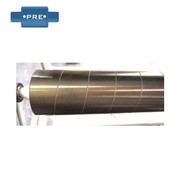
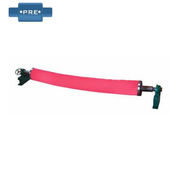
The non-metallic idler refers to a roller made of a non-metallic material such as ceramic, rubber or plastic.
1 ceramic roller
The ceramic roller is sintered with clay and has the advantages of wear resistance, corrosion resistance, oxidation resistance and high running stability. It can effectively prevent belt deviation, reduce local wear of the belt, prolong the service life of the belt and the service life of the ceramic roller. More than 2 times longer than ordinary steel rollers. In addition, the ceramic roller has high temperature resistance, oxidation resistance and corrosion resistance, and is suitable for various harsh environments. However, the disadvantages of the complicated forming process, heavy weight, poor toughness and low installation precision of the ceramic roller limit its application range. .
2 rubber roller
The rubber roller is a combined roller with a rubber sealing ring on the surface of the roller of the ceramic or metal roller [1]. The wear resistance and cushioning properties of this roller provide excellent protection for transport. However, because the rubber idler is a combined idler, the price is more expensive than the steel idler and the ceramic idler; in addition, the thermal expansion coefficient of the rubber and the ceramic and the metal are different, which greatly shortens the actual service life.
3 plastic rollers
The plastic idler is a plastic-based roller. At present, there are mainly the following:
3.1 nylon roller
Nylon has the advantages of high toughness, good elasticity, good insulation, heat resistance, wear resistance, corrosion resistance, weather resistance, etc. It is a good engineering material for plastics, steel, iron, copper and other metals.
According to the patent report, the inherent strength of the nylon material is high, and the weight is light, and it is liquidized, and a mixture of a flame retardant, a preservative, an anti-aging agent and a curing agent is added, and then a vacuum pumping process is performed. The water is removed and poured into a high-speed rotating cylindrical mold. After heating and solidification, a nylon cylinder is formed, which is heat treated, machined and penetrated into the cylinder with a bearing shaft. A nylon roller having antistatic, corrosion resistance, light weight and long life is produced.
Patent CN 201180040 Y discloses a nylon roller. The bearing seat and the roller are made of PA nylon material, which has the characteristics of light weight, small running resistance, small radial runout, small wear on the tape, long service life and corrosion resistance.
Ultra high molecular weight polyethylene roller
Ultra High Molecular Weight Polyethylene is a new type of engineering plastic that is resistant to abrasion, corrosion, and impact. It is self-lubricating several times that of copper.
Liu Guangjian and others used a three-way sealing structure to obtain an ultra-high molecular weight polyethylene roller by press molding. Compared with the metal roller, it has the characteristics of light weight, abrasion resistance, corrosion resistance and antistatic, and the sealing performance is also obtained. Enhanced, more suitable for coal mine wet, dusty working environment.
Lu Bin et al. developed ultra-high molecular weight polyethylene rollers using rare earth modified super-high molecular weight polyethylene. The roller has a friction coefficient of 0.05~0.11, a tensile strength of 34MPa, a tensile elongation at break of 360%, and an operating temperature of ≤132°C. It has light weight, wear resistance and corrosion resistance, and has a service life of up to 25,000 hours. the above.
Urea-formaldehyde resin roller
Urea-formaldehyde resin is a thermosetting resin and is one of the most widely used amino resins. It is an insoluble and infusible resin made by the condensation of urea and formaldehyde under acidic conditions or a basic catalyst under certain conditions, in the presence of a curing agent or auxiliary agent [7].
Hebei Luzhou Guangtong Mining Equipment Factory developed a urea-formaldehyde resin roller, which has the advantages of antistatic and flame retardant performance compared with steel idler, and its wear resistance and corrosion resistance are better than steel under the same conditions. The quality roller is more than 5 times higher.
Polyurethane roller
The internal structure of the polyurethane roller is a polyurethane elastomer, which is a new type of polymer synthetic material between rubber and plastic, which has both high strength of plastic and high elasticity of rubber.
Patent CN 201746067U reports a polyurethane roller. The roller has reasonable structure, small working resistance, wear resistance, corrosion resistance, good elasticity, waterproof and dustproof, no noise operation, and is widely used in metallurgy, mining, dock, coal, building materials and other industries.
2 PVC roller
Polyvinyl chloride resin has the advantages of acid and alkali resistance, corrosion resistance, impact resistance, wear resistance, good toughness and non-conductivity.
Li Xiang uses polyvinyl chloride to make rolls and housings, built-in labyrinth seals, and adopts roller shafts for oil injection and cooling. The roller has the characteristics of light weight, convenient replacement, flame retardant, antistatic, corrosion resistance, fatigue resistance and impact resistance.
Patent CN 202464709 U reports a polyvinyl chloride roller which has strong antistatic property, excellent flame retardant performance and corrosion resistance of more than 10 times that of steel idler. It has long service life and light weight and can be used in coal mines. In the working environment with the danger of gas or coal dust explosion.
Compared with ceramic rollers and rubber rollers, plastic rollers have the advantages of light weight, impact resistance, corrosion resistance and low noise at high speed. In addition, plastics can be recycled after the plastic rollers are scrapped. However, its heat resistance, wear resistance and strength are not as good as ceramic and metal rollers, and its high price also limits its promotion and application.
Polymer-based composite roller
In recent years, with the development of polymer science, the use of polymer-based composite materials instead of metal, ceramics, rubber, plastics to manufacture rollers has become the focus of research in this field, and is also the future development direction. The market urgently needs new high-performance roller materials with good performance, low price, long service life, more targeted application environment and quick replacement.
Yan Zhenhui and others used phenolic resin, short cotton fiber, filler, flame retardant, antistatic agent, curing accelerator and mold release agent to develop a polymer-based composite roller by compression molding. The roller has excellent machinery. Physical properties and high levels of flame retardant and antistatic properties can be adapted to the harsh and dangerous working environment of coal mines.
Liu Guangjian et al. obtained a roller by using ultra-high molecular weight polyethylene modified by ultra-fine glass beads, copper powder, molybdenum disulfide, silane coupling agent, etc. The roller has a simple structure, low cost and no lubrication. Overcoming the phenomenon of stuck, the temperature resistance and wear resistance have also improved.
Chen Lin filled MC nylon with glass fiber and graphite to develop an MC nylon roller. The roller is resistant to wear, has a long service life, and has a low cost. However, nylon is low in brittleness, which limits its use in low temperature environments.
3 Conclusion
With the continuous development of modern industry, the requirements for the comprehensive performance of the rollers are also constantly increasing. The use of polymer-based composite materials instead of steel, ceramics, rubber, and plastic to manufacture rolls has gradually become an inevitable trend in this field. In recent years, although the polymer-based composite material for the idler has improved in impact resistance, abrasion resistance, corrosion resistance, tear resistance, and the like, there are still various problems. To this end, it is still the direction of our future efforts to develop a polymer-based composite material for rollers that is inexpensive, has excellent performance, and has a more targeted application environment.