Tel: +86-134-31394972
E-mail: sales@pre-webguidesystem.com
Tel: +86-134-31394972
E-mail: sales@pre-webguidesystem.com
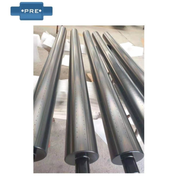
One of the common flattening rolls of aluminum alloy opener rolls is composed of outer curved aluminum alloy hollow sheets, rollers, inclined wheels and mandrels. Three sets of curved aluminum alloy hollow sheets are arranged on the surface of the rolls. The middle group is fixed on the roller, and the groups on both sides are embedded in the groove of the roller, and the ends are connected on the outwardly inclined wheels on both sides. Next, the flattening roller manufacturer will detail the working principle, characteristics and use of the aluminum alloy open roll.
First, the working principle of aluminum alloy open roll
When the sheet rotates following the roller body, the sheet drives the tilting wheel to rotate, and the tilting wheel drives the sheet to reciprocate outward and inward. The sheet moves outward when moving from 0o to 180o, and moves inward when moving from 180o to 360o. When the substrate is wrapped around 0o--180o, it is flattened by axial stretching of the outwardly moving sheet.
Second, the characteristics of aluminum alloy open roll
It has strong flattening ability and can withstand the tensile force of large substrate. It is suitable for thicker substrates. It is easy to flatten and debug, just turn the mandrel slightly, and it can be eliminated after various adjustments. Wrinkles, no need to adjust frequently.
Third, the use of aluminum alloy open roll
Aluminum alloy open roll can be widely used in textile, printing and dyeing, printing, paper making, film, composite, coating and non-woven fabrics. The applicable linear speed is less than 90m/min, and the applicable substrate wrap angle is 90o-- 180o.
Structural principle
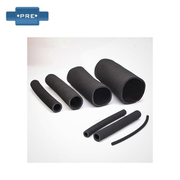
Mainly composed of rubber strip, aluminum alloy roller body, adjustable runner, mandrel and shaft seat.
A lateral groove is evenly distributed on the surface of the aluminum alloy roller body, and the rubber strip is embedded in the groove and is higher than the roller body to form a roller surface arranged by the rubber strip. The two ends of the strip are respectively connected to the outwardly inclined runners on both sides of the roller body (the degree of tilt is controlled by the handwheel adjustment on the axle seat).
When the strip rotates following the roller body, the strip drives the skew wheel to rotate, and the skew wheel gradually pulls the strip toward the shaft end. The strip is gradually elongated to the maximum value when it is rotated from 0° to 180°. When it is turned from 180° to 360°, it is gradually reduced from the maximum value to the original length. When the substrate wraps around the above 0°-180° strip, it can be flattened by following the strip to the ends.
2, characteristics
1The mold is stretched and stretched flat, the flattening ability is strong, the substrate is evenly stressed, the flattening mode is soft, and the substrate is not deformed.
2 high speed, small amount of jitter, no noise, safe and reliable
3 Light weight, low inertia and low torque
4 rubber strip wear resistance, dynamic fatigue resistance, aging resistance, corrosion resistance, durability
5 The length of the strip (stretching) can be obtained by adjusting the tilt angle of the wheel by the hand wheel on the shaft seat, that is, the greater the inclination, the longer the strip is stretched. Once you adjust the wrinkles caused by various reasons, you can eliminate them.
6 It can be driven by passive rotation or by adding the pulley, sprocket, motor, etc. to the extended end of the mandrel to become the active rotation, and also can reduce the rotational torque to zero, so as to achieve the longitudinal untensioned flat.
The strip-type flattening roller is the best flattening effect so far, and is widely used in the fields of textile, printing and dyeing, paper making, plastics, packaging, printing and the like. It can be applied to thin and thick substrates, especially suitable for ultra-thin, super-soft, ultra-light, easy to stretch, and low tension substrates, such as film, paper, silk, knitted fabrics, etc.