Tel: +86-134-31394972
E-mail: sales@pre-webguidesystem.com
Tel: +86-134-31394972
E-mail: sales@pre-webguidesystem.com

The photoelectric guide control system is a system for controlling the horizontal position shift of thin soft materials during the transmission process, and has functions of automatic detection, automatic tracking, automatic adjustment and the like. It can automatically track and correct the marking lines or edges of paper, film, non-dry tape, aluminum foil, copper strip, steel strip, non-ferrous metal and other industries to ensure winding and slitting.
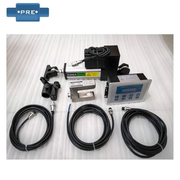
The photoelectric sensor or the gas sensitive probe is installed at a position that moves together with the winding platform, and is driven and corrected by the motor screw or the hydraulic cylinder, so that the rolled material is not biased with respect to the sensor or the probe, so that the collected volume is neat. The correction system consists of an automatic control system consisting of a controller, an edge detection/detection line sensor, an electric drive, and a correcting mechanism. The correcting sensor detects the relative position of the edge, the line or the color block of the coil, converts it into an electric signal and transmits it to the guiding controller, and the guiding controller compares the signal with the set signal, and according to the deviation amount, the controller outputs a proportional proportional The signal is corrected immediately to the electric drive.
The guide control system adopts high-speed microprocessor, digital, modular and intelligent circuit design; advanced program design, user-friendly interface, LCD screen display; high-performance components and perfect circuit protection design to make the system run continuously and stably; The control system reaction time is less than 0.01 seconds; the system's own accuracy is up to 0.01mm. During the material winding process, the position of the edge or line is detected by the photoelectric sensor to pick up the edge correction frame or the line position deviation signal.
The rectification control system transmits the position deviation signal to the photoelectric rectification controller for logic operation, sends a control signal to the mechanical actuator, drives the mechanical actuator, corrects the serpentine deviation of the material during operation, and ensures linear movement of the material. Optional left and right limit switches prevent the system from running out of control.
What are the operation and maintenance requirements for photoelectric guide sensors?
1. Neat: tools, workpieces, and accessories are placed neatly; safety protection devices are complete; line piping is complete.
2, clear: internal and external cleaning; all sliding surfaces and screws, gears, racks and other oil-free, no bumps; no oil leakage, no water leakage, no air leakage, no leakage; cleaning debris.
3, lubrication: oil on time, oil quality, oil quality meets the requirements; oil pot, oil gun, oil cup, linoleum, oil line clean and complete, oil standard is bright, oil flow is smooth. 4. Safety: Implement the system of fixed and fixed shifts; familiarize with the maintenance structure of the guide system and observe the operating procedures, use the guide system to maintain, carefully maintain the tools, and prevent accidents.
The principle of daily mechanical maintenance and the daily maintenance of equipment are the basic work of equipment maintenance, and must be institutionalized and standardized. For the regular maintenance of equipment, work quotas and material consumption quotas shall be established, and assessment shall be carried out according to the quota. The regular maintenance work of equipment shall be included in the assessment content of the workshop contract responsibility system.
Regular inspection of equipment is a planned preventive inspection. In addition to the human senses, the inspection methods must also have certain inspection tools and instruments. The inspections are carried out according to regular inspection cards. Regular inspections are also called periodic inspections. The mechanical equipment should also be checked for accuracy to determine the degree of accuracy of the equipment.
The photoelectric correction sensor manufacturer stated that in order to ensure that the mechanical equipment is always in a good technical state, it can be put into operation at any time, reduce the downtime, improve the mechanical integrity rate, utilization rate, reduce mechanical wear, prolong the service life of the machine, and reduce the mechanical operation and maintenance cost. For safe production, it is necessary to strengthen the maintenance work of mechanical equipment.