Tel: +86-134-31394972
E-mail: sales@pre-webguidesystem.com
Tel: +86-134-31394972
E-mail: sales@pre-webguidesystem.com
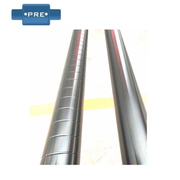
Types of expansion rolls: 1 Bending roll expansion: The expansion of the bending roll is relatively good, and the adaptability to the product is strong, but the expansion amount should be small and not large, otherwise it is easy to produce curved weft, rubber bending roll It has a lower service life than the active threaded roller and the opener roller. The wrapping angle of the fabric on the bending roll should not be too large or too small, and the wrap angle of the fabric should be within the range of 180° roll surface of the bending roll rotation to have the effect of expanding the wrinkle.
The expansion amount of the bending roller is small. If the expansion effect of the single bending roller is not satisfactory, a plurality of bending roller combinations are required, and generally three bending rollers are expanded and five bending rollers are expanded. 2 Threaded roller: The amount of expansion of the threaded roller is very limited, but it is very effective when it is used as a driving roller. The adaptability of the threaded roller is relatively small, because the device is slightly slippery, resulting in an increased probability of scratching. Offsets can also occur, and active threaded rolls are more prone to offset.
3 Open roll: The open roll surface has axial spokes. If the active roll is used, the effect will be very good. When it is a passive roll, the driving force is not enough when the tension is low, because the driving force of the expansion is from the fabric. Traction. The opening roller has a relatively small adaptability to the variety because the device has a relative slip phenomenon, which increases the probability of scratching, and also causes an offset phenomenon. The threaded roller is not suitable for elastic fabric expansion, and the opening roller is easy to run off.
The development of large diameter, low tension rubber bending rolls is an improved direction.
Installation of the expanding roller: The expanding roller is generally installed before the fabric enters the rolling mill and the drying cylinder, and the fabric is easy to wrinkle in the steamer with a large capacity. The expanding bending roller is directional. The direction of the active expanding roller is opposite to the running direction of the fabric. The passive expanding roller has the same running direction as the fabric, and the expanding roller has a much wider expansion effect than the passive roller.
If the active expansion roller is fixed, it also has a widening effect, but if the passive expansion roller is fixed, it will not only expand the amplitude, but will play the role of the width.
Expanding effect: The installation position of the bending roll, the opening roll and the thread roll has a great relationship with the wrap angle of the fabric, otherwise the expansion function will be greatly reduced. The angle of the expanding bending roller should be well grasped, otherwise the weft shift will occur, and the processed fabric will be prone to weft; the threaded roller should pay attention to the wrapping angle of the fabric with the fabric.
The covering angle is too large, and it is easy to produce straight wrinkles. If the covering angle is too small, the expansion effect is not achieved. The relative speed of the active threaded roller and the fabric is regular. Different fabrics have different relative velocities and are adjusted to the optimum speed for both scratch and widening. A worm gear mechanism is provided on the bearing housing of the operating side bending roller, and it is more convenient to manually adjust the angle of the bending roller.
If the fabric is not afraid of being scratched, and there is relative slip between the fabric and the passive thread roller, the effect of the expansion will be very good. If the active thread roller does not cooperate with the centering device, once the fabric deviates from the middle position, it will quickly run. The edge of the roll face, while the passive thread roll does not have this problem, but adds extra tension. Therefore, the ideal method is to add the passive thread roller to the variable speed motor to adjust the optimum speed to take into account the effect of the scratch and the expansion. However, due to the electrical part, the difference between the high and low speed ratios is difficult to control, and the equipment must meet this requirement. There are still some difficulties.
In actual production, the soil method adopted in many cases is to kill the passive roller to achieve a better expansion effect.