Tel: +86-134-31394972
E-mail: sales@pre-webguidesystem.com
Tel: +86-134-31394972
E-mail: sales@pre-webguidesystem.com
There are many types of cloth guide rollers, and the common types can be summarized into three categories:
A large category: cloth guide rollers used in textile, paper and leather, packaging and mining industries: natural rubber rollers, nitrile rubber rollers, neoprene rubber rollers, etc. The advantages of this type of cloth guide roller are: good alkali resistance Performance, excellent elasticity and mechanical strength, excellent oil resistance, wear resistance, aging resistance, heat resistance, etc.
Two categories: cloth guide rollers used for printed board corrosion machines, plastics, tanning, printing, food printing iron, ordinary coating machines and other equipment: butyl rubber rollers, ethylene-propylene rubber rollers, the advantages of this type of cloth guide roller Yes: It has high resistance to chemical solvents, good heat resistance (170℃), excellent acid and alkali resistance, excellent ozone aging resistance, weather resistance, wide operating temperature, and can be under -65℃-140℃ Long-term work, excellent insulation performance, etc.
Three categories: cloth guide rollers commonly used in papermaking, chemical fiber, wood processing, plastic processing and other machinery: polyurethane rubber rollers, silicone rubber rollers, fluorine rubber rollers, etc. The advantages of this type of cloth guide roller are: It has extremely high mechanical strength and abrasion resistance, aging resistance and oil resistance. It is used for processing hot-adhesive products, such as polycarbonate, with high temperature resistance, ozone resistance, chemical inertness and non-adhesion to plastics. Ethylene calendering, embossing, printing and dyeing, film and fabric coating adhesives, plastic compounding, corona treatment and other machinery, are also used as release rollers on sugar production and packaging machines and non-woven fabric manufacturing. It has extremely high heat resistance, oil resistance, acid and alkali resistance, gas permeability resistance, electrical insulation, aging resistance, flame resistance, and abrasion resistance.
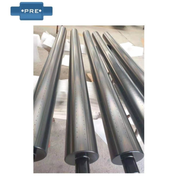
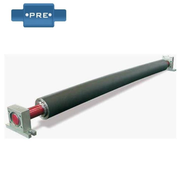
The cloth guide roller is specially designed for the open-width threading and guiding of various dyeing and finishing machinery and equipment, which can effectively prevent the fabric from wrinkling. It is a general-purpose part in the dyeing and finishing machine. The use of the cloth guide roller avoids the phenomenon of fabric wrinkles and discounts, speeds up the work process and speed, and is an indispensable accessory for the current dyeing and finishing equipment.
The structure of the cloth guide roller has ordinary TMG type and composite MT001 type, which can be selected according to your own needs. Generally, the material of the shaft head and the inner layer of the roller is carbon steel, the width of the roller body is 180 mm, and the center distance of the bearing installation is 2300 mm, which can effectively prevent the pollution of textiles by rust and improve the utilization rate.
Fabric guide roller processing requirements: smooth surface, no scars, cracks, rust spots, unevenness and other defects harmful to use; roller body roughness: polished to Ra less than 1.6 pm, smooth surface can reduce the abrasion of textiles, and also The service life of the cloth guide roller can be increased.
Previous: Understand The 6-step Process Of Rubber Bending Roll Processing Encapsulation
Next: What Are The Maintenance Procedures For Aluminum Guide Rollers?