Tel: +86-134-31394972
E-mail: sales@pre-webguidesystem.com
Tel: +86-134-31394972
E-mail: sales@pre-webguidesystem.com
Soft ink rollers (commonly known as rubber rollers) are generally made of high-grade polymers such as vulcanized natural rubber, synthetic rubber, gelatin, and polyurethane; rigid ink rollers (commonly referred to as metal rollers), generally iron Made of copper or other metal materials. The rubber roller and the metal roller themselves have good lipophilicity, so that the ink is well wetted and adhered on the surface, which is a prerequisite for ensuring the transfer of ink between the ink rollers. The rubber roller refers to a roller-shaped product made of metal or other material as a core and the outer rubber is vulcanized. The ink roller on the press is mainly used to transfer ink. In order to distribute the ink rapidly and evenly between the ink rollers, the printing machine is usually arranged in an alternating manner between a soft ink roller and a hard ink roller to make good contact between adjacent ink rollers.
First, the manufacturing process of rubber roller: the main raw materials include high molecular polymer, vulcanizing agent, plasticizer, filler, accelerator; main process and role: mixing - filtration - curing treatment - grinding - polishing.
1. Mixing: Control the content of each component, heat drying temperature, etc., to stabilize the hardness and composition.
2. Filtration: make the colloid even and free of impurities. This is especially important for high-speed printing presses: uniform force during high-speed operation, uniform transmission of energy due to various factors, even when expanding or contracting, so that only relying on adjustment can reduce or avoid adverse effects.
3. Curing: By heating and pressing and vulcanization treatment, the speed-increasing agent is stabilized, so that the rubber shrinks to a minimum when subjected to external force. The soft and ductile compound is made into a solid material with a certain degree of softness, which is more suitable for ink transfer and transfer.
4, grinding and polishing: the key to determine the size and surface area of the rubber roller, especially the arc treatment of the alcohol water roller. The rubber surface looks smooth, but under a high magnification magnifier, there are many small bumps and depressions. These raised and recessed portions increase the surface area of the rubber roller, giving it superior ink transfer and transfer properties. This process requires a constant temperature: the temperature is too high, the surface is easily charred, and peeling occurs when printing is short-time. The temperature is too low, and the part is easily embrittled, resulting in a decrease in ink transfer performance.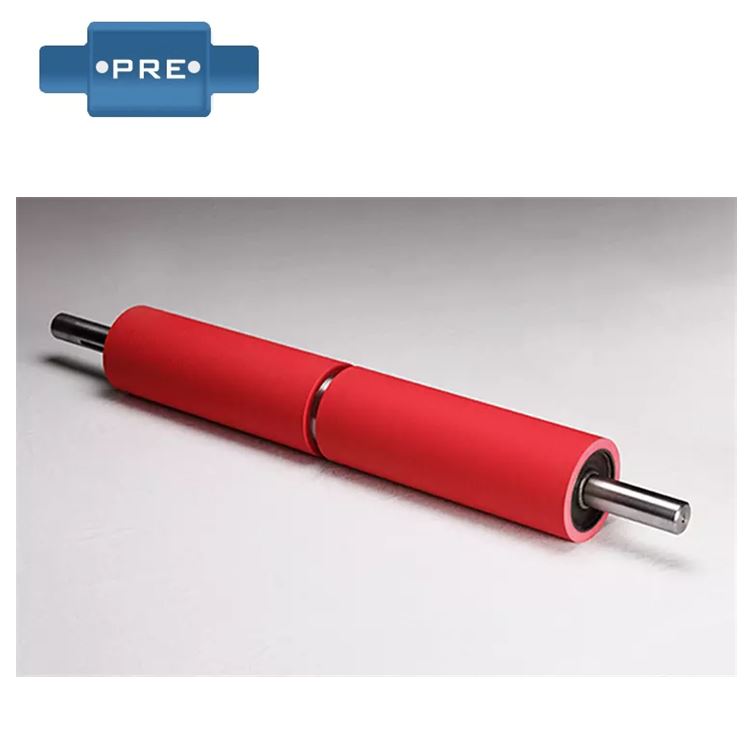 Second, the performance requirements of the rubber roller:
1. Inclusiveness - affinity for water and ink;
2, flexibility - whether the pressure can be correctly expressed; the elasticity of good pressure performance is obvious;
3. Indentation reflection - the basis for correct adjustment of printing pressure;
4, shock absorption - to prevent up and down, resonance (high speed);
5, wear resistance - maintain high surface area, anti-glaze ability, and maintain inclusive; 6, energy transfer performance - to ensure that they do not accumulate energy, do not reflect energy;
7, corrosion resistance - good chemical resistance, help to extend life;
8. Conductivity - antistatic, non-adsorbing ink and paper hair;
9, heat transfer - extend their life and reduce the time to adjust the pressure;
10, high temperature resistance - extend the life of the rubber roller itself (especially for high speed machines).
Third, the rubber roller hardness: Rubber roller hardness is an important performance of the rubber roller performance, the specific performance is as follows:
1, soft - good tolerance, large elasticity, strong pressure resistance, good vibration absorption, good impression of indentation, large adjustment range of pressure.
2, has a certain hardness - not easy to be corroded and worn, strong resistance to high temperature, rapid pressure performance, so the hardness of the rubber roller needs to be moderate: too soft, poor corrosion resistance, easy to gather energy; too hard, the ability to transfer ink, poor vibration absorption, Easy to gradually destroy the precision design of the printing press.
Therefore, it is necessary to select the correct gel type and hardness according to the appropriate printing pressure and other printing suitability.\
Previous: Reasons Affecting The Life Of The Rubber Roller
Next: How To Prevent Cracks On The Surface Of Polyurethane Rubber Roller?