Tel: +86-134-31394972
E-mail: sales@pre-webguidesystem.com
Tel: +86-134-31394972
E-mail: sales@pre-webguidesystem.com
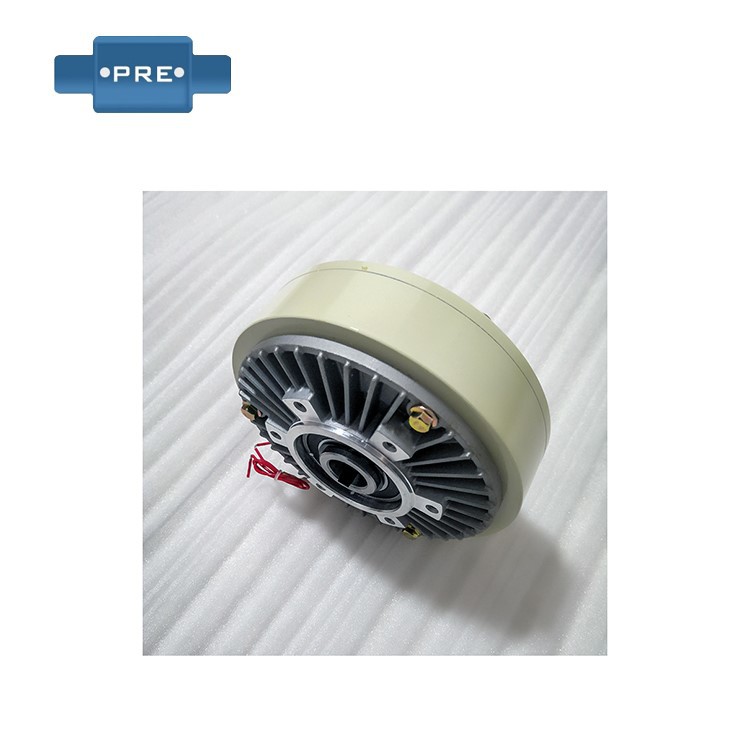
Due to the development of modern industrial machinery, a variety of new structural types of brakes have emerged, among which caliper disc brakes, magnetic particle brakes and electromagnetic brakes are the most widely used. It is roughly divided into two categories: friction brakes and non-friction brakes, which are classified as follows:
1) Friction brakes, which can be divided into disc brakes, external block brakes, internal expansion shoe brakes, belt brakes, comprehensive belt brakes, double shoe brakes, multi-hoof brakes, simple belt brakes, single disc brakes, multi-disc brakes, fixed caliper brakes, floating brakes, etc.
2) Non-friction brakes, which can be divided into magnetic powder brakes, magnetic eddy current brakes, water eddy current brakes, etc.
About Disc Brakes:
Disc brakes are hydraulic type, controlled by hydraulic pressure, and the main components are brake discs, cylinders, brake calipers, oil pipes, etc. The disc brake dissipates heat quickly, is light in weight, simple in structure and easy to adjust. Especially when high load, high temperature resistance is good, the braking effect is stable, and not afraid of muddy and water invasion, in winter and bad road conditions, many cars use disc brakes have plane brake disc, perforated brake disc and scribing brake disc, in which the braking effect and ventilation and heat dissipation capacity of the scribing brake disc are relatively good.
About Electromagnetic Brakes:
1) Working principle: The friction ring rotates together with the brake drum, and the electromagnet and the driving lever are connected together by a circlip. When braking starts, the controller sends a braking signal, and the electromagnet is energized, generating electromagnetic attraction, which is adsorbed on the friction ring. Since the electromagnet is constrained by the driving lever, it sliding relative to the friction ring, and the friction acting on the electromagnet drives the driving lever connected to it to rotate around the fulcrum. The driven end of the lever opens the two friction shoes of the brake and presses them against the brake drum to produce a power torque. At the end of braking, the electromagnet is de-energized, the suction and friction force disappear, and under the action of the return spring tension, the friction shoes leave the brake drum and the brake is released.
2) Application field: Electromagnetic brake is an ideal automatic actuator in modern industry, which mainly plays the role of transmitting power and controlling movement in mechanical transmission system. It has the advantages of compact structure, simple operation, sensitive response, long life, reliable use, and easy to achieve long-distance control. It is widely used in metallurgy, construction, chemical industry, food, machine tools, stages, elevators, ships, packaging and other machinery, as well as braking (anti-risk) when the power is off.
About Magnetic Particle Brakes:
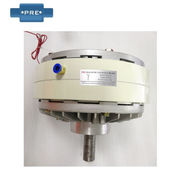
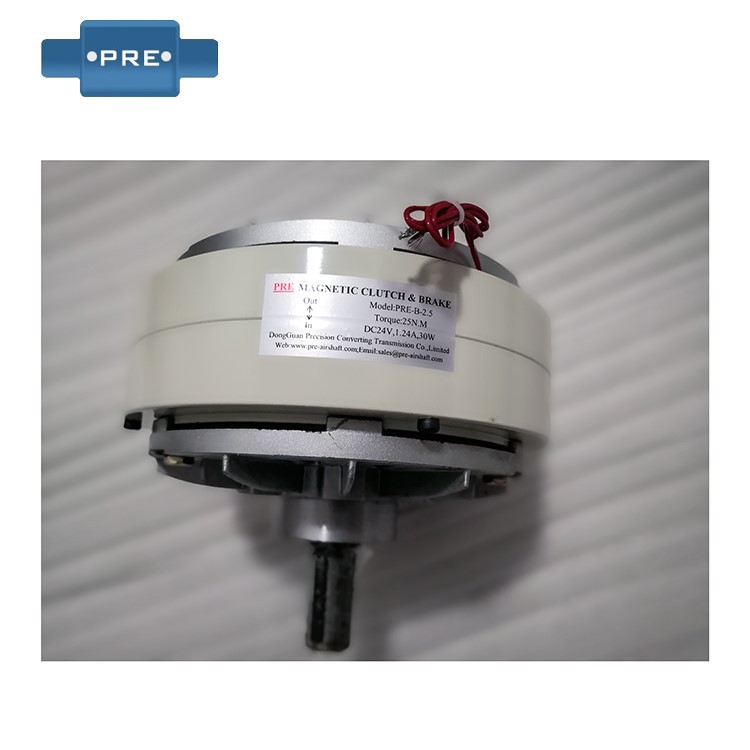
1) Structural composition: magnetic podwer brakes usually include the main structure, coil, power controller and sensor. The main structure includes stator, rotor and brake disc, which is the basic component of magnetic particle brake. The stator is the fixed part of the brake that contains the coil and the magnetic powder to fill the gap. The rotor is the rotating part of the brake that is fixed to the shaft and connected to the motor or other transmission. The brake disc is a metal disc on the rotor that realizes the braking or braking function through the work of the brake. Classified according to structure: hollow shaft magnetic powder brake and single-shaft magnetic particle brake.
2) Working principle and characteristics: The magnetic particle brake is based on the electromagnetic principle and the use of magnetic powder to transmit torque. It has the characteristics that the excitation current and the transmission torque are basically linear. It can transmit a certain torque under the condition that it has nothing to do with the slip difference, and has the advantages of fast response, simple structure, no pollution, no noise, no impact vibration, energy saving and so on. It is a multi-purpose automatic control element with superior performance. It has been widely used in papermaking, printing, plastics, rubber, textile, printing and dyeing, wire and cable, metallurgy, tablet press and other related winding processing industries in unwinding and winding tension control. Magnetic particle brakes are also often used for dynamometer loading and braking of transmission machinery.
3) Selection: Before selection, determine the application intention: such as load, continuous sliding, winding, tension control, starting, aborting, etc. Functional requirements: such as heat dissipation work, torque, response speed, control accuracy, control scale, etc., the selection of magnetic particle brakes is generally selected based on the maximum torque to be transmitted, and at the same time pay attention to ensure that the actual slip power is less than the allowable slip power of the magnetic particle clutch and brake.
4) Applications: a. Industrial field: Magnetic particle brakes are often used in the braking systems of various machinery and equipment, such as lifting machinery, winding machines, punching machines, cutting machines, etc. Because magnetic particle brakes have the characteristics of fast response and precise control, they can provide stable braking effect, so they are widely used in industrial production.
b. Transportation: The application of magnetic particle brakes in vehicles is also common. For example, in e-bikes, electric vehicles, and electric vehicles, magnetic particle brakes can achieve adjustable braking force to improve driving safety and comfort.
c. Air traffic and aerospace field: In the aerospace field, magnetic particle brakes are used to control and adjust the attitude of aircraft and satellites to achieve accurate attitude control and stability.
d. Other fields: Magnetic particle brakes have some other special applications, such as medical equipment, electronic equipment, instrumentation and other fields. In these areas, magnetic particle brakes are often used to achieve some precise control and adjustment functions.
Contact factory in Guangdong, China
(Over 20 years experience in brake,clutch production )
Previous: How often should magnetic particle be replaced for magnetic particle brakes and clutches?
Next: Which Magnetic Powder Brake Is Suitable For Your Machine