Tel: +86-134-31394972
E-mail: sales@pre-webguidesystem.com
Tel: +86-134-31394972
E-mail: sales@pre-webguidesystem.com
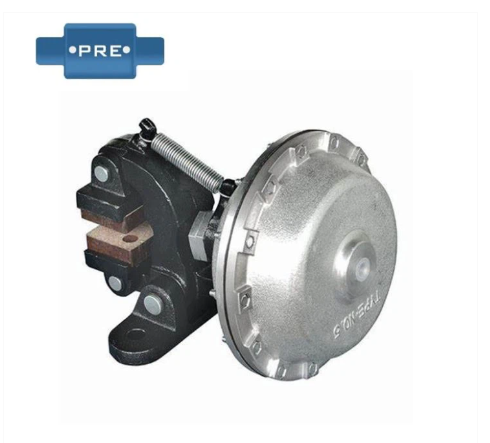
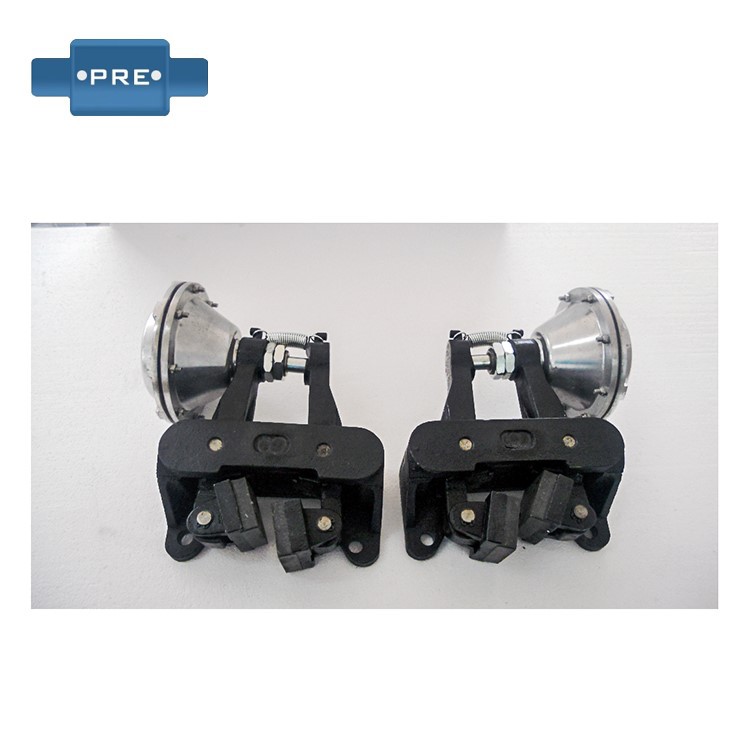
Pneumatic brake is a brake that works based on the mechanical properties of gas, which realizes the braking effect on mechanical equipment by converting gas pressure into braking force.
Pneumatic brakes are referred to as air brake and pneumatic hydraulic pneumatic brakes, etc., which belong to one of the industrial transmission brakes, and are the actuators that use air pressure to stop or decelerate moving parts in machinery. The structure is simple, easy to install, not easy to damage, anti-compression, anti-drop and anti-knocking, long service life, generally only need to replace the brake pads, the replacement is easy, simple and convenient.
Its working principle can be simply summarized as the following steps: first, the gas pressure is provided through the gas source to feed the gas into the brake; Then, the gas pressure acts on the piston inside the brake, causing the piston to move outward; Finally, the movement of the piston is transmitted to the brake pads of the brake through the transmission mechanism such as the connecting rod, so as to achieve the braking effect.
Features of pneumatic brake operation:
1) High braking force: Pneumatic brakes can increase braking force by increasing air pressure to adapt to different braking needs.
2) Flexibility: The pneumatic brake can be easily controlled and adjusted to achieve a flexible braking effect.
3) Durability: The pneumatic brake has a simple structure and few parts, so it has high durability and reliability.
Compared with other ordinary brakes, Air Brake are different in the following aspects:
1) Compared with hydraulic brakes, pneumatic brakes do not require liquid as the working medium, so there is no problem of liquid leakage and contamination. In addition, pneumatic brakes are more responsive and easier to operate.
a. Structural comparison:
Pneumatic brakes: The main components of pneumatic brakes include air supply, piston and cylinder, brake pads and discs, and control systems. The air source provides the gas pressure, the cylinder and the piston form a device, the brake pads are in contact with the brake disc to produce friction, and the control system adjusts the contact force between the air source and the brake pads.
Hydraulic brakes: Hydraulic brakes consist of a hydraulic system, hydraulic cylinders, brake pads, and brake discs. The hydraulic system drives the movement of the brake pads through the pressure of the liquid, the hydraulic cylinder converts the liquid pressure into mechanical force, and the brake pads are in contact with the brake disc to produce brake friction.
b. Comparison of the scope of application:
Pneumatic brakes: Pneumatic brakes are suitable for mechanical equipment and construction machinery. Due to its high braking force, high flexibility and fast response, pneumatic brakes can meet the braking needs of heavy construction machinery and large vehicles that require high braking power.
Hydraulic brakes: Hydraulic brakes are suitable for construction machinery, ships and port equipment. The hydraulic brake achieves the braking effect through the transmission of liquid pressure, and its large braking force and stability make the hydraulic brake can adapt to the braking needs of large loads and harsh environments.
c. Comparison of advantages and disadvantages:
The advantages of pneumatic brakes include large braking force, high flexibility, fast response, simple structure, etc. However, pneumatic brakes also have some drawbacks, such as the need for a supply of air and susceptibility to external factors such as temperature and humidity.
The advantages of hydraulic brakes include large braking force, high control accuracy, good stability, etc. Hydraulic brakes also have some disadvantages, such as more complex hydraulic systems and higher maintenance costs.
2) Compared with electromagnetic brakes, pneumatic brakes have greater braking force and are suitable for braking of large machinery and heavy equipment. In addition, pneumatic brakes are not affected by magnetic fields and do not cause electromagnetic interference to the surrounding environment.
Areas of application of brakes:
Brakes are widely used in machine tools, motors, packaging machinery, printing machinery, papermaking machinery, textile machinery, office equipment, metallurgical machinery, tobacco machinery, automated production equipment and woodworking machinery and other mechanical transmission systems, and are widely used in life.
Contact factory in Guangdong, China
(Over 20 years experience in brake,clutch production )
Previous: No Information
Next: The Difference Between Magnetic Powder Brake And Air Disc Brake