Tel: +86-134-31394972
E-mail: sales@pre-webguidesystem.com
Tel: +86-134-31394972
E-mail: sales@pre-webguidesystem.com
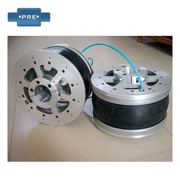
Magnetic particle brake is a kind of self-cooling, air-cooled, liquid-cooled, and electric fan-cooled brake that fills the working gap between the stator and the rotor, transmits power and motion with the help of the binding force between the magnetic powder generated by electromagnetic attraction and the friction between the magnetic particle and the working surface, and can control and adjust the torque.
Magnetic powder clutch, also known as electromagnetic powder clutch, magnetic powder clutch, is based on the electromagnetic principle and the use of magnetic powder to transmit torque, with the excitation current and the transmission torque is basically a linear relationship, in the case of irrelevance to the slip can transmit a certain torque, with fast response, simple structure, no pollution, no noise, no impact vibration energy saving and other advantages, is a multi-purpose, superior performance of the automatic control element.According to the shaft type, there are: dual-shaft magnetic powder clutch, hollow shaft magnetic powder clutch,and according to the cooling method, there are self-cooled, air-cooled and water-cooled, etc.
Magnetic powder is a necessary material for torque transmission of magnetic particle brakes and magnetic powder clutches, and magnetic powder is a consumable that changes with time, temperature, quality and other factors. Magnetic powder has a certain lifespan and needs to be replaced from time to time. The replacement procedure is as follows:
1. Place the magnetic particle brake or magnetic particle clutch on the rack prepared in advance (upside down), with the input shaft facing down and the output shaft facing upward, pay attention to the stable placement of the magnetic powder;
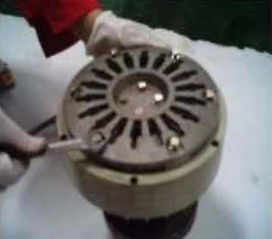
2. Use a wrench to loosen the aluminum cover fixing bolt at the end of the bolt output shaft and take it out;
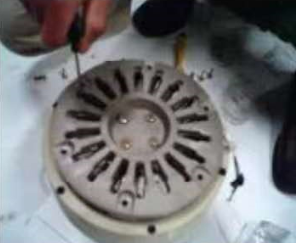
3. After removing the aluminum cover, loosen the bolts of the stator and take out the stator;
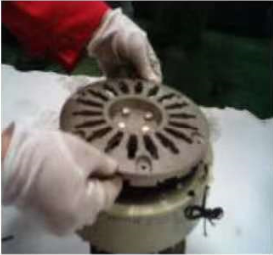
4. After taking out the stator, clean up the magnetic particles left inside, and clean the inner wall with a clean rag;
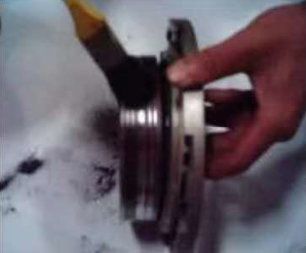
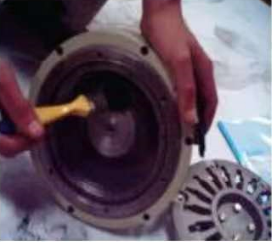
5. After cleaning, please seal the prepared magnetic powder according to the specifications (unit is g);
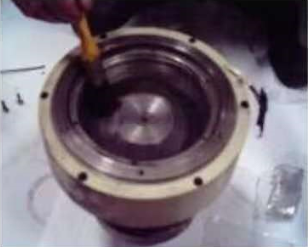
6. After adding magnetic particle, please fix the stator, stator bolts, aluminum cover, aluminum cover bolts, etc. according to the original position, this step is very important, if you are careless, it will lead to leakage of magnetic particle;
7. After sealing the magnetic powder and fastening it, please test run the magnetic particle clutch before it can be put into use after there is no abnormality.
Tools/Raw Materials:
Rag, clean, dust-free and water-free cloth, used to clean the inner wall of the magnetic particle clutch;
magnetic powder, newly prepared magnetic powder; a wrench, which is used to loosen bolts;
Bracket for flat placement of the magnetic particle clutch.
When the magnetic particle brake and magnetic particle clutch are used for a period of time, the magnetic powder needs to be replaced in time, which requires certain technical requirements, and non-professionals are advised not to disassemble, and it is recommended to contact the magnetic particle brake and magnetic particle clutch manufacturer for replacement operation. Precautions when replacing magnetic particles:
1. The magnetic powder must have enough mesh (in strict accordance with the rated catalog), and the bolts (fasteners) of each component must be tightened.
2. Be careful of moisture. If the magnetic particle is wet, the performance will become unstable, so be careful not to let oil or moisture get inside. In particular, when the gearbox is installed, the oil enters the shaft through the shaft, so it is completely sealed with a film.
3. Pay attention to the surface temperature. The maximum surface temperature caused by continuous operation is 90 degrees Celsius or less during operation, and if this value is exceeded, the durability is greatly reduced. Be sure to use the limit temperature as the standard, and be sure to keep it within the allowable sliding working rate when using.
Previous: Precautions For The Installation And Use Of Magnetic Powder Clutches
Next: How To Quickly Distinguish Between A Magnetic Powder Brake And A Magnetic Clutch?