Tel: +86-134-31394972
E-mail: sales@pre-webguidesystem.com
Tel: +86-134-31394972
E-mail: sales@pre-webguidesystem.com
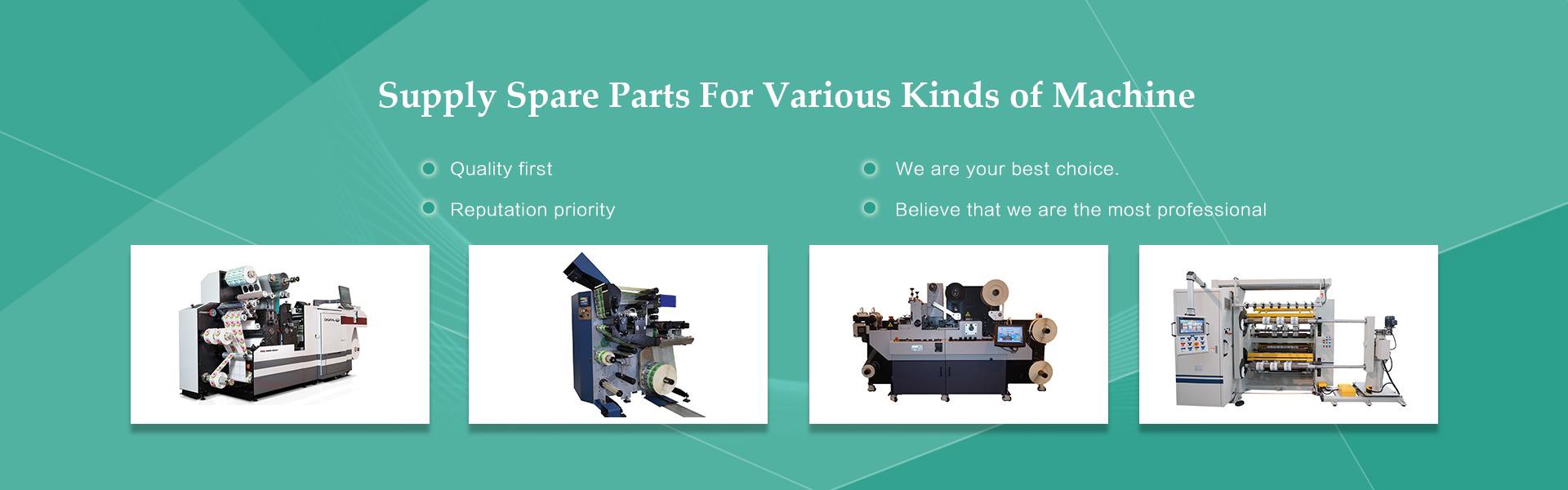
The flexographic printing machine uses fluid ink with strong fluidity, the ink is transmitted to the graphic part of the printing plate by the ink fountain rubber roller and the anilox ink transfer roller and makes it inked, and then the printing pressure is applied by the pressure cylinder to transfer the ink on the printing plate to the substrate, and finally the printing process is completed by the drying surface.
In flexographic printing, what is the function of anilox rollers:
In flexographic printing, the function of the anilox roller is to transfer the ink evenly. And the amount of ink depends on the number of anilox rollers.
The anilox roller is also a kind of metering ink transfer roller, and the amount of ink that the anilox roller can transfer mainly depends on the number of mesh lines (the number of mesh arrangements per inch of length) and the mesh
The amount of ink transfer through the hole (mesh volume) is determined. Prints (printing plates) with different number of lines need to have anilox rollers corresponding to the number of network lines and ink transfer to transfer ink Finish printing.
Types of anilox rollers:
The early anilox rollers were mechanically engraved copper rollers and chrome-plated on the copper rollers to improve wear resistance and increase ink carrying.
Anilox rollers are classified according to the materials coated or sprayed on their surfaces, mainly including chrome-plated anilox rollers and ceramic anilox rollers. Both kinds of anilox rollers have good ink transfer performance, but the price of ceramic anilox rollers is high. When the printing speed reaches 200mmin in the printing of high-precision screen wire plates, the ceramic anilox roller can show its advantages of wear resistance and heat resistance, but practice has proved that the ink hole of the ceramic roller is easy to block, and attention must be paid to cleaning and maintenance during application. Due to the plating, the ink cavity of the metal anilox roller is not easy to block, but the service life is not as good as that of the ceramic roller.
Surface structure of anilox roller:
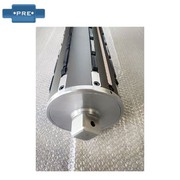
There are many tiny concave holes with the same shape evenly distributed on the surface of the anilox roller, which are generally called "ink holes", and it is these ink holes that play the role of ink storage, ink uniformity and quantitative ink transfer in printing. The inking holes are generally carved in a 45° direction to the axis, and the partition wall between the inking holes is called the "mesh wall", and the area of the mesh wall is related to the shape of the ink hole.
Number of anilox roller wires and angle of wires:
The amount of ink transfer of the anilox roller is generally measured by the number of wire lines. The number of lines refers to the number of ink holes engraved per centimeter. Generally speaking, the ink supply of the anilox roller decreases with the increase of the number of network cables. Practice has proved that in order to obtain high-quality prints, the number of screen lines of the anilox roller should maintain a certain proportional relationship with the number of printing plate plus screen lines, that is, the number of screen lines of the anilox roller should generally be about 4 times that of the number of printing plate plus screen lines. For solid printing, if the number of screen lines of the anilox roller is too low, the ink supply is too large, and the edge of the printing plate is ghosted due to ink accumulation; If the number of network cables is too high, the ink supply is insufficient, and the actual density is not enough. In practice, the number of lines must be reasonably selected according to the amount of ink supply.
There is no uniform regulation on the angle of the network cable of the anilox roller, and the actual work shows that the ideal network cable is more than 30 degrees and 60 degrees, but the more applied is 45 degrees, and the basic principle of determining the angle of the network cable should be to reduce the moiré stripe (tortoise).
Consider the ratio of the number of threads between the anilox roller and the printing plate:
1) It depends on whether the substrate is offset paper or coated paper, or film: ground, offset paper selection
The anilox roller wire is generally 300~350 lpi, the coated paper is generally 400~450 lpi, and the film is generally 400~450 lpi
500~550 lpi; 150 lpi hierarchical screen cable version, offset paper uses anilox roller network cable 600lpi, coated paper uses anilox roller network cable 750 lpi, thin
The film is made of anilox roller wire 900lpi.
2) Look at the anilox roller and ink: try to use a thin ink layer to achieve the best printing effect. The mesh volume determines the thickness of the ink layer, and the appropriate mesh is selected
The volume can not only ensure the ink load of the mesh, but also ensure the maximum transfer of ink.
The thin ink layer can achieve the smallest dot expansion, the fastest drying speed, the maximum printing speed, the smallest ink consumption, and the best print quality.
How to achieve a thin ink layer: Choose the right one according to the type of printing plate (solid, line, layer), substrate, ink type and quality.
The scraping method will also affect the quality of ink transfer on the anilox roller:
The closed squeegee system is the main component of modern flexo printing machines, corrugated box printing grooving machines, coating machines, glazing machines, and it has the ability to improve flexographic plates
The advantages of printing quality, increasing printing speed, saving ink or coatings, and improving the working environment are called the "cardiovascular" of flexo printing machines.
Because in the printing process, due to the effect of the squeegee knife, the anilox roller will produce a certain amount of wear, and over time, the opening of the ink hole will gradually become smaller, and the depth will gradually become shallow, so that the ink transfer of the anilox roller will decrease, and the total amount of ink transmitted will gradually decrease. Therefore, the coating (chromium or ceramic) on the surface of the anilox roller is of great significance to improve the wear resistance of the anilox roller and prolong the service life of the anilox roller.